Friday, February 14, 2014

Charlie Bean said: 'The international net investment position is the most important figure.' Photograph: Stefan Rousseau/PA


The City operated like a "giant hedge fund" in the runup to the financial crisis, and the resulting crash could leave the British economy with permanent low productivity and stagnant earnings, according to a senior Bank of England official.

Charlie Bean, the Bank's deputy governor responsible for monetary policy, added that the UK's foreign investment hot streak had cooled and was unlikely to fully recover. A shrinking surplus on investment income from abroad could spook markets and trigger a sharp fall in sterling, he said.

Asked whether Britain could be stuck in a "new normal" of a low-productivity and low-investment economy, Bean said: "It is always possible. We do not fully understand the current weakness of productivity. We have done a lot of work on it down to company level to try to get a better picture. There have been some plausible explanations, one of which, of course, is the possibility that the official data may understate the position."

Bean, who leaves the Bank on 30 June after 14 years of service, said the Office for National Statistics was "doing its best", but some surveys suggested that the British economy was growing more strongly.

"Business surveys suggest output growth is a bit stronger than the official data. Employment growth suggests the same. There may be a measurement error in the data. This should not be taken as a criticism of the ONS. Inevitably, the ONS numbers are just estimates. The division of labour is that the ONS does its best to measure what is happening, and we interpret."

Bean added that a sustainable recovery requires three pillars: a rise in business investment, a pick-up in productivity growth and an expansion in exports.

Britain's current account was last in balance or surplus in 1983, but, Bean said, while the foreign investment figure is the most important, its apparent health belies a contribution from the City that is unsustainable.

"Despite our having run deficits for many years, this net position is close to balance … in large part that is a result of our having run a surplus on investment income' In other words, our investments abroad produced better returns than foreign investors achieved in Britain. Up to the crisis, we were a bit like a giant hedge fund."

But he added that the blow dealt to the financial services sector by the credit crunch could have permanent consequences for the deficit. "There has been a recent deterioration in that component of our current account performance," he said. "Is it likely to be long-lasting or temporary? My view is that it may come back a bit, but not all the way back to where we were before the financial crisis.

"Will that leave us in trouble? I would hesitate to say so, in the sense that countries can run deficits for years. But certainly an adverse net position would leave us vulnerable, making it more likely for the exchange rate to fall sharply were investors to lose faith in the economy. We have seen that happen in the emerging markets."

Commenting on his plans after leaving Threadneedle Street, he said: "The first thing I am going to do is take a holiday in Italy. Then I shall re-establish links with academia [he was a professor at the London School of Economics before joining the Bank] and, I hope, do some interesting things, including in my role as president of the Royal Economic Society."

He added: "It will be only semi-retirement."
guardian news

Why the European Central Bank should buy American

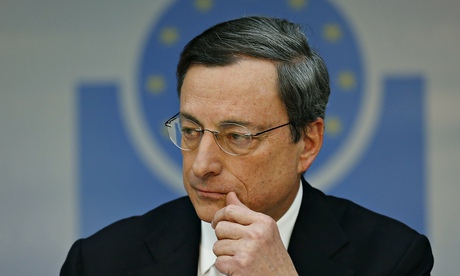
European Central Bank president Mario Draghi faces legal obstacles if the ECB embarks on quantitative easing. Photograph: Ralph Orlowski/Reuters
The European Central Bank needs to ease monetary policy further. Eurozone-wide inflation, at 0.8%, is below the target of "close to 2%", and unemployment in most countries remains high.

Under current conditions, it is hard for the periphery countries to reduce their costs to internationally competitive levels, as they need to do. If inflation in the eurozone as a whole is below 1%, the periphery countries are condemned to suffer painful deflation.

The question is how the ECB can ease policy, given that short-term interest rates are already close to zero. Most of the talk in Europe concerns proposals to undertake quantitative easing (QE), following the path taken by the US Federal Reserve and the Bank of Japan. This would mean expanding the money supply by buying member countries' government bonds – a realisation of the ECB president Mario Draghi's "outright monetary transactions" scheme, announced in August 2012 in the midst of growing uncertainty about the euro's future (but never used since then).

But QE would present a problem for the ECB that the Fed and other central banks do not face. The eurozone has no centrally issued and traded Eurobond that the central bank could buy. (And the time to create such a bond has not yet come.) By purchasing bonds of member countries, the ECB would be taking implicit positions on their individual creditworthiness.

That idea is not popular with the eurozone's creditor countries. In Germany, ECB purchases of bonds issued by Greece and other periphery countries are widely thought to constitute monetary financing of profligate governments, in violation of the treaty under which the ECB was established. The German constitutional court believes that the outright monetary transactions scheme exceeds the ECB's mandate, though it has temporarily tossed that political hot potato to the European court of justice.

The legal obstacle is not merely an inconvenience; it also represents a valid economic concern about the moral hazard that ECB bailouts present for members' fiscal policies in the long term. That moral hazard – a subsidy for fiscal irresponsibility – was among the origins of the Greek crisis in the first place.

Fortunately, interest rates on Greek and other periphery-country debt have fallen sharply over the last two years. Since he took the helm at the ECB, Draghi has brilliantly walked the fine line required to "do whatever it takes" to keep the eurozone intact. (After all, there would be little point in upholding pristine principles if doing so resulted in a breakup, and fiscal austerity alone was never going to return the periphery countries to sustainable debt paths.) At the moment, there is no need to support periphery-country bonds, especially if it would flirt with illegality.

What, then, should the ECB buy if it is to expand the monetary base? For several reasons, it should buy US treasury securities. In other words, it should go back to intervening in the foreign-exchange market.

For starters, there would be no legal obstacles. Operations in the foreign-exchange market are well within the ECB's remit. Moreover, they do not pose moral-hazard issues (unless one thinks of the long-term moral hazard that the "exorbitant privilege" of printing the world's international currency creates for US fiscal policy). Finally, ECB purchases of dollars would help push down the euro's exchange rate against the dollar.

Such foreign-exchange operations among G7 central banks have fallen into disuse in recent years, partly owing to the theory that they do not affect exchange rates except when they change money supplies. But in this case we are talking about an ECB purchase of dollars that would change the euro money supply. The increase in the supply of euros would naturally lower their price. Monetary expansion that depreciates the currency is more effective than monetary expansion that does not, especially when, as is the case now, there is very little scope for pushing short-term interest rates much lower.

Depreciation of the euro would be the best medicine for restoring international price competitiveness to the periphery countries and reviving their export sectors. Of course, they would devalue on their own had they not given up their currencies for the euro 10 years before the crisis (and if it were not for their euro-denominated debt). If abandoning the euro is not the answer, depreciation by the entire eurozone is.

The euro's exchange rate has held up remarkably during the four years of crisis. Indeed, the currency appreciated further when the ECB declined to undertake any monetary stimulus at its meeting on 6 March. Thus, the euro could afford to weaken substantially. Even Germans might warm up to easy money if it meant more exports.

Central banks should and do choose their monetary policies primarily to serve their own economies' interests. But proposals to co-ordinate policies internationally for mutual benefit are fair. Raghuram Rajan, the governor of the Reserve Bank of India, has recently called for the advanced economies' central banks to take emerging-market countries' interests into account via international co-operation.

ECB foreign-exchange intervention would fare well in this regard. This year, the emerging economies are worried about a tightening of global monetary policy, not the policy loosening that three years ago fuelled talk of "currency wars." As the Fed tapers its purchases of long-term assets, including US treasury securities, it is a perfect time for the ECB to step in and buy some itself.

Copyright: Project Syndicate, 2014.

Thursday, February 13, 2014

Comcast takeover of Time Warner Cable 'will throttle choice on the web'

Comcast is America’s largest cable company. Photograph: Brendan McDermid/Reuters


Consumer groups reacted angrily to the merger of cable giant Comcast and Time Warner Cable on Thursday, claiming the combination could “throttle” choice on the internet.

Comcast’s proposed $45.2bn takeover of TWC will create a media behemoth that will dominate broadband internet access across the US. Comcast, which owns NBC Universal, will also cement its position as the pre-eminent force in cable TV.

Jodie Griffin, senior staff attorney at consumer rights group Public Knowledge said: “This is a deal that needs to be blocked.” She said Comcast was likely to use the extra leverage to “drive up costs and reduce choices for consumers.”, and claimed the new company would be too powerful, becoming a “gatekeeper” capable of “throttling competition.”

Comcast, America’s largest cable company, took over NBC Universal in 2011 and was given a long list of conditions by the Federal Communications Commission (FCC). Among them was a commitment to net neutrality – a ban on internet service providers from favouring affiliated content or blocking or slowing web content sent to homes and businesses. At present, Comcast is bound to abide by net neutrality rules until the end of 2017.

Netflix CEO Reed Hastings has attacked Comcast, accusing the cable firm of capping data it provides to streaming companies like his own in order to favour Comcast’s own Xfinity video-on-demand app. Recent studies show that Comcast users receive their Netflix media at significantly slower speeds than those using other internet service providers.

Griffin said there were other examples where Comcast had failed to live up the pledges it had made or was pushing hard at the limits of the rules. She cited Comcast’s dispute with Bloomberg Television. Bloomberg clashed with Comcast after the cable firm refused to put its business news channel alongside its own affiliated news stations – including rival finance channel CNBC and MSNBC – in its cable lineup. The FCC ruled last year that the refusal to “neighbourhood” Bloomberg’s channel close to its rivals contravened the conditions of its NBC merger.

“In our experience, allowing this merger to go through with added conditions is not a workable solution,” said Griffin.

Craig Aaron, president of internet rights lobby group Free Press, said that while the immediate effects of the merger were likely to be price rises and less competition, the long-term consequences could be even more serious.

Alongside Netflix, Comcast has been criticised for slowing users’ broadband connections by the lobby group Electronic Frontier Foundation (EFF) and by file-sharing and copyright website TorrentFreak for interfering with legal file-sharing on the web.

“This is a company that has already been caught blocking internet traffic,” said Aaron. “But it’s clear their long-term plan is to take a free and open internet and turn it into something like cable TV, where they pick the channels and they speed them up and slow them down based on who pays them the most.”

“If you hate your cable guy now, you are going to hate your cable guy on steroids,” said Aaron.

EFF attorney Mitch Stoltz called the merger “dangerous”.

“One company will effectively control the only data pipe going into a near majority of American homes, whether that’s internet TV or phones,” Stoltz said. “If that company gets to play favourites … that’s dangerous.”

Stoltz said the companies might not compete directly, but that their combined marketing and purchasing power would give them unprecedented clout over programming whether it was delivered to TVs or to the internet. “At this point that is largely an irrelevance,” he said.

The two firms have begun what looks set to be an expensive and protracted lobbying effort to sell the consumer benefits of the deal.

On a conference call with journalists Thursday, Brian Roberts, the chairman and CEO of Comcast, and Robert Marcus, the chairman and CEO of TWC, argued the deal was a “pro-consumer”. They said the two firms did not directly compete geographically and would sell off the small areas where they do.

“If there is a benefit of a national scale of being able to grow in the future with capabilities that are expensive and untested that require a national presence, we are able to do that,” said Roberts.

Marcus said: “First of all, the broadband market today is more competitive than you give it credit for. But most importantly, by combining Time Warner and Comcast in cable, we are not removing a competitor from any consumer. We are not removing a choice from any consumer.”

in New York

Tuesday, February 11, 2014

Boehner backs down and drops Republican demands on debt ceiling


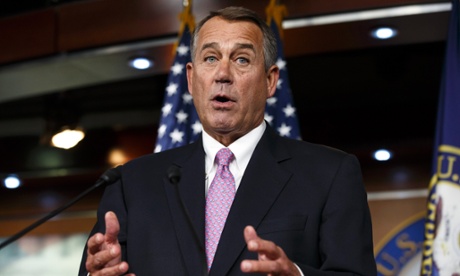
John Boehner. Republican leaders showed little appetite for another showdown with the White House. Photograph: J Scott Applewhite/AP

Republican leaders backed away from a confrontation with the White House over the US borrowing limit, conceding on Tuesday that their party was too divided to press their demand for concessions from the administration in return for raising the debt ceiling.
John Boehner, the Republican speaker of the House, told fellow lawmakers he would quickly bring legislation to increase the Treasury’s debt limit, without any extraneous requests attached.
The so-called “clean” debt bill, set to be put to a vote later on Tuesday, marks a capitulation from Republicans to Senate Democrats and the Obama administration, who have been insisting on the measure for weeks.

Even with Democratic support, Republicans in the House will need to muster at least 18 votes to pass the bill, which extends the Treasury’s borrowing capacity to enable it to pay debts associated with spending that Congress has already approved.
Passage of the clean debt bill had been pencilled in for Wednesday, but Boehner expedited the process because of an impending snowstorm.

That third and final vote on the debt limit extension was expected at 6.45pm on Tuesday evening, giving Republicans just a few hours to secure the backers from their party. If even a small number of Democrats vote against the legislation, passage of the bill could be complicated.
The US government has been using what it calls “extraordinary measures” to keep its accounts rolling since Friday. The Treasury secretary, Jack Lew, had warned Congress that those measures would soon expire, saying the debt ceiling would need to be raised by 27 February to avoid a possible default.

With the House due to embark on a two-week recess, that left just a handful of days to increase the debt limit or risk default. The White House steadfastly refused to negotiate with Republicans, saying they were holding the economy to ransom.
Republican leaders, conscious their party has a reputation for obstructionism – which was compounded during last October’s failed debt limit fight – showed no enthusiasm for another showdown with the White House in an election year.

Still, they openly – if half-heartedly – toyed with making approval for an extended debt ceiling contingent on a number of different proposals, such as approval of the the Keystone XL pipeline or attacks on aspects of Obama’s signature healthcare law.
Neither idea gained much traction, and on Monday night, Boehner presented a last-ditch proposal linking the debt ceiling rise to the re-introduction of military pension benefits, which had been cut from the recent budget.

By Tuesday morning, it was evident that Republicans were unwilling to rally around that idea. A GOP source confirmed that Boehner told fellow Republicans in a private meeting that he would table a vote a clean debt limit bill, a move that will require an overwhelming majority of Democrats to pass.
“You’ve all known that our members are not crazy about voting to increase the debt ceiling,” Boehner later told reporters, according to Politico. He added: “We’ll let the Democrats put the votes up; we’ll put a minimum number of votes up to get it passed.”

The saga underscores the disarray in the Republican party and mirrors Boehner’s recently stalled push for immigration reform. He and other leaders had hoped to pass measures before the summer that would enable a path to legal recognition for undocumented workers.
Top GOP legislators presented their plans at a Republican retreat last month, portraying the move necessary in order to rebrand the party and improve its appeal to Hispanic voters.
Less than a week later, Boehner conceded the pitch did not go down well with rank-and-file members, saying immigration reform “would be difficult to pass this year”.

Boehner tried to blame his immigration U-turn on lack of trust in the Obama administration. On Tuesday, he adopted a similar approach when trying to explain the debt limit surrender.
“Our members are also very upset with the president,” he said. “He won’t negotiate. He won’t deal with our long-term spending problems without us raising taxes. He won’t even sit down and discuss these issues. He’s the one driving up the debt and the question they’re asking is, why should I deal with his debt limit?”

Despite Republican infighting, Washington has experienced a flurry of bipartisan legislative progress over the past month, passing the budget, appropriations and farm bills in relatively quick succession.
Presuming the debt limit legislation passes – which is not guaranteed, given the strength of GOP opposition to a clean bill and the limited time needed to find the votes – Congress should have created the space for other, non-essential legislation in the spring.
However, with the midterm elections nine months away, Republicans do not want to rock the boat with bills that could prove politically unpopular with their base.


Monday, February 10, 2014

Car industry: what Australia could learn from state support around the world

The US was the most successful, and most ambitious, example of intervention with the managed bankruptcies of General Motors and Chrysler which were supported financially by the government. Photograph: Stan Honda/AFP/Getty Images
Car manufacturing is a proud pillar of the western world's industrial history, but the hollowing out of Detroit as a city and an economic force is just the most shocking example of a decline that has afflicted automotive superpowers such as the US, the UK, France and now Australia, where Toyota will close all of its factories by 2017. But in recent years some of those countries have at least stopped the rot. And government intervention has been key in rebuffing the global pressures – cheaper labour elsewhere, deteriorating consumer confidence, excess factory capacity – that have seen car plants shut all over the world since the credit crunch exposed an over-expanded and over-leveraged industry.
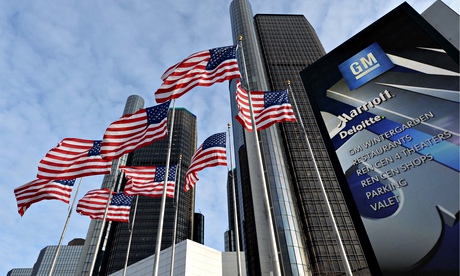
The US was the most successful, and most ambitious, example of intervention with the managed bankruptcies of General Motors and Chrysler which were supported financially by the government. "Despite being seen as a free market, the US had an industrial policy to rescue those car manufacturers and get them to shift to new low-carbon vehicles," said David Bailey, professor of industrial strategy at Aston University business school. Without government intervention, the US car industry would not have survived on its current scale, he said.
In an unsentimental, Thatcherite view of the world, two of Detroit's biggest companies would have been allowed to go to the wall – they weren't fleet-footed enough for a global car market that had seen the likes of Toyota enter GM and Chrysler's backyard. But the Bush and Obama administrations took the view that the collapse of two-thirds of the Detroit triumvirate – Ford came through relatively unscathed – would have ramifications that stretched far beyond Motor City, with hundreds of thousands of jobs at risk in the supply chain.
State support has also played a crucial role in the UK and Bailey credits the UK's "more intelligent industrial policy" since the financial crisis in keeping car manufacturing in the country. He estimates that a state-sponsored programme to diversify the manufacturing base, into medical technology and car parts, helped to save 10-12,000 jobs in the West Midlands following the closure of MG Rover. By contrast, the Australian government, he says, has tended to fall back on the natural resources boom, rather than use a limited period of state support to adjust to changes in the world economy.
In the UK, government support was key in the saving of the Vauxhall plant at Ellesmere Port on the Wirral in 2012, when business secretary Vince Cable and the Unite trade union thrashed out a deal with GM that kept the 50-year old plant open. This flexibility on the part of unions, underpinned by support from a government that understands the importance of car manufacturing albeit without the financial firepower to back it with a radical financial intervention, has persuaded Japanese manufacturers such as Nissan and Honda to stay in the UK. A spokesman for the Society of Motor Manufacturers and Traders said the British industry had learned from poor industrial relations that characterised the 1970s, citing better links between carmakers and unions, as well as the government, as one of the reasons why British car manufacturing is thriving.
The UK's heritage brands also help. As a hub for making luxury vehicles including the Mini, Bentley, Jaguar and Land Rover, Britain has also benefited from China and the emerging world's appetite for luxury cars. Indian-owned Jaguar Land Rover flirted with a bailout during the credit crunch but has added thousands of British jobs since as demand for vehicles like the Evoque took off globally.
"We can do everything here and we have got a proven pedigree in developing what markets want all over the world," said the SMMT spokesman, citing the fact that 50% of vehicles produced in the UK are exported outside Europe. The SMMT expects that the UK will soon overtake France as Europe's third largest car market, behind Germany and Spain.
In France, state support has been forthcoming too, but has until recently served to prop up factories that need trimming back. European car manufacturing remains predicated on a pre-2008 world and the French establishment's reluctant acceptance of the closure of Peugeot's Aulnay plant outside Paris was a sign that governments can no longer support the status quo. Carmakers have to get leaner without cutting back on investment in new, greener models. German car makers still dominate in the luxury market because they are underpinned by decades of government support for manufacturing as a broad sector covering products from white goods to factory machinery to cars, while a state-level banking system has helped maintain a thriving culture of small-to-medium sized suppliers, or mittelstand. Maintaining a car industry is a marathon, not a sprint. Something a sporting nation like Australia would appreciate.